


Earliest writing in today's Bulgaria
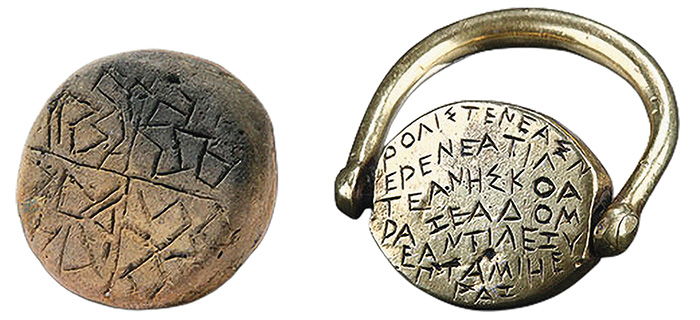
The 4th-millennium BC Karanovo's clay seal is considered one of the oldest examples of "writing" in the world (left); The 5th-century BC gold ring from Ezerovo is in Thracian, in Greek letters. Both artefacts are in the National Archaeological Institute with Museum at the Bulgarian Academy of Sciences
For most of us, "writing" simply means the signs that record speech. We rarely stop to consider that writing is an independent system, with its own internal logic, structure and rules. In an European context, we automatically think of an alphabet – letters that represent sounds. In doing so, however, we tend to overlook other graphic systems: pictograms, symbolic signs and complex sets of images that also transmit information. Whether or not they contain phonetic value, all of these are forms of written communication.
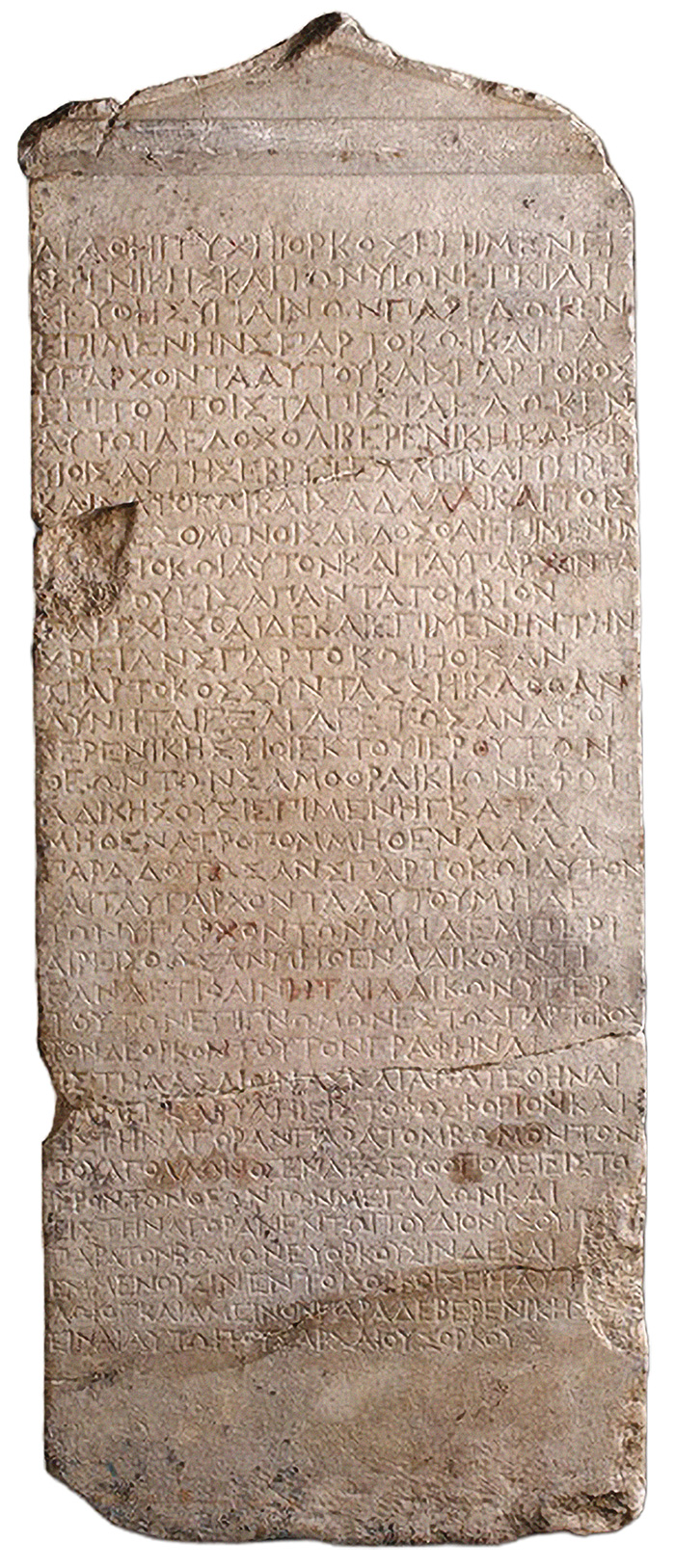
Marble slab from the ancient city of Seuthopolis, 3rd century BC, outlining, in Greek, a peace treaty with another centre of Thracian power, the city of Cabyle. National Archaeological Institute with Museum at the Bulgarian Academy of Sciences
The lands of present-day Bulgaria preserve traces of some of humanity's earliest attempts to "record" the world. Dating from the 5th to the 3rd millennia BC, these artefacts take us back to the dawn of writing culture. The Gradeshnitsa tablet, for example, bears 24 signs that some scholars interpret as among the oldest written symbols in human history. Comparable in fame is the clay stamp known as a pintadera from the 5th millennium BC found in Karanovo, as well as the 4th-millennium tablet discovered near the village of Dolnoslav, near Plovdiv – a row of signs strikingly reminiscent of letters. This is not an alphabet in the modern sense, but it is clear evidence of early graphic thinking.
Genuinely phonetic alphabets appear later. Remarkably, three of the alphabets are still in use today – Greek, Latin and Cyrillic – were used in what is today's Bulgaria.
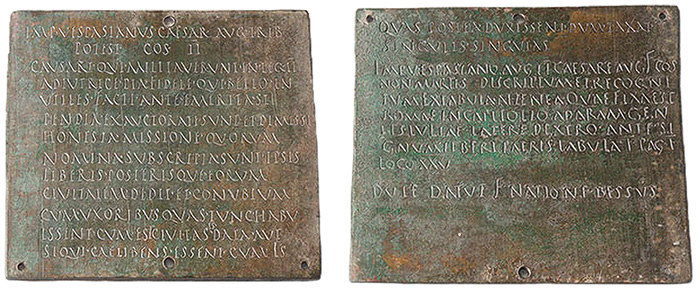
A military diploma issued by Emperor Vespasian in 70 AD to veterans of the Roman army. One of the mentioned is Dula, son of Datus, from the Bessoi Thracian tribe. The diploma was found in the village of Breznik. National Archaeological Institute with Museum at the Bulgarian Academy of Sciences
The Phoenicians created the first practical phonetic system – a tool for merchants, easy to learn and adapt. The Greeks transformed it radically in the early 8th century BC, introducing vowels and adapting it to their language. The earliest Greek inscriptions date from this period.
In the Bulgarian lands, the Greek alphabet was first used to record the Thracian language. The 5th century BC gold ring from the village of Ezerovo remains one of the most enigmatic monuments; its inscription remains a subject of debate. Possibly even earlier are the Greek letters carved on the stele from the stone tomb near the village of Kyolmen, dating to the late 6th century BC.
Later, the Greek language and script dominated a vast corpus of inscriptions spanning more than a millennium, among them the marble slab from the ancient city of Seuthopolis, near today's Yambol, bearing a sworn treaty from the 3rd century BC.
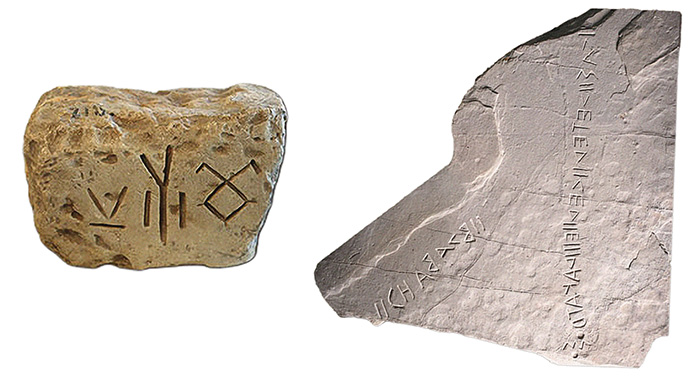
Stone with Proto-Bulgarian runes, including the distinctive IYI symbol. National History Museum; The 6th century BC Kyolmen Inscription is yet another example of writing with Greek letters in the Thracian language. National Archaeological Institute with Museum at the Bulgarian Academy of Sciences
With the establishment of Roman rule over what is now Bulgaria, in the 1st century AD, Latin written culture also spread widely. Inscriptions from the Roman provinces of Macedonia, Thrace and Moesia are scattered across almost the entire territory of Bulgaria. They preserve the voices of emperors, soldiers, priests and ordinary people – in dedicatory texts, military diplomas, funerary inscriptions, sacred formulas and even milestone columns.
In the 4th century, Greek once again became dominant – alongside Christianity, which relied on written texts to transmit doctrine and Scripture. It was here, in the city of Nicopolis ad Istrum, that the Gothic alphabet emerged, created by Bishop Wulfila for the translation of the New Testament. Combining elements of Greek and Latin scripts, it demonstrates how writing could be deliberately crafted as an instrument of faith.
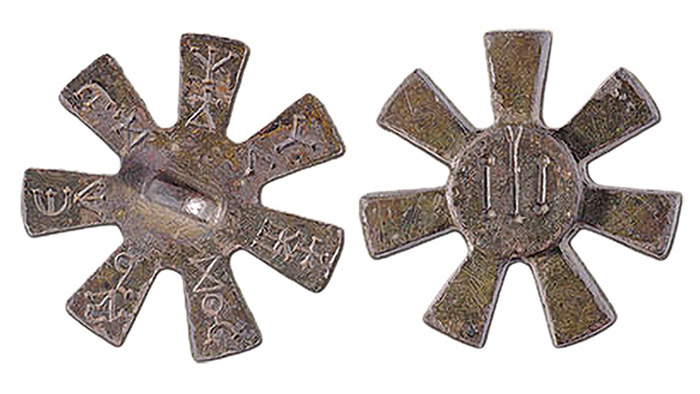
The Pliska Rosette is a bronze object made between the 7th and 9th centuries and covered in Proto-Bulgarian runes. Their exact meaning is unknown. National Archaeological Institute with Museum at the Bulgarian Academy of Sciences
With the arrival of the Bulgars in the Balkans in the 7th century came the so-called Proto-Bulgarian runic signs – hundreds of incised, painted or cast symbols discovered mainly in their first capital south of the Danube, Pliska, and its surroundings. They attest to a well-developed tradition of symbolic communication derived from the northern Black Sea region, though not yet a fully structured alphabetic system.
The true state-written tradition of early Bulgaria is reflected in the inscriptions of the 8th-9th centuries. With one exception, they are written in Greek, yet they express the political reality of the Bulgarian rulers. Some are triumphal, others commemorative or military. The inscription from Byal Bryag – the only known text written in Greek letters but in the Proto-Bulgarian language – appears to be a list of weapons.
The corpus of Proto-Bulgarian inscriptions is a distinctive phenomenon of profound significance. It marks the beginning of the Bulgarian literary tradition, laying the foundations for a new written culture shaped by the richness of its own language and ultimately expressed through its own alphabets – the Glagolitic and the Cyrillic.
* Prof Slavia Barlieva works at the Cyrillo-Methodian Research Centre at the Bulgarian Academy of Sciences
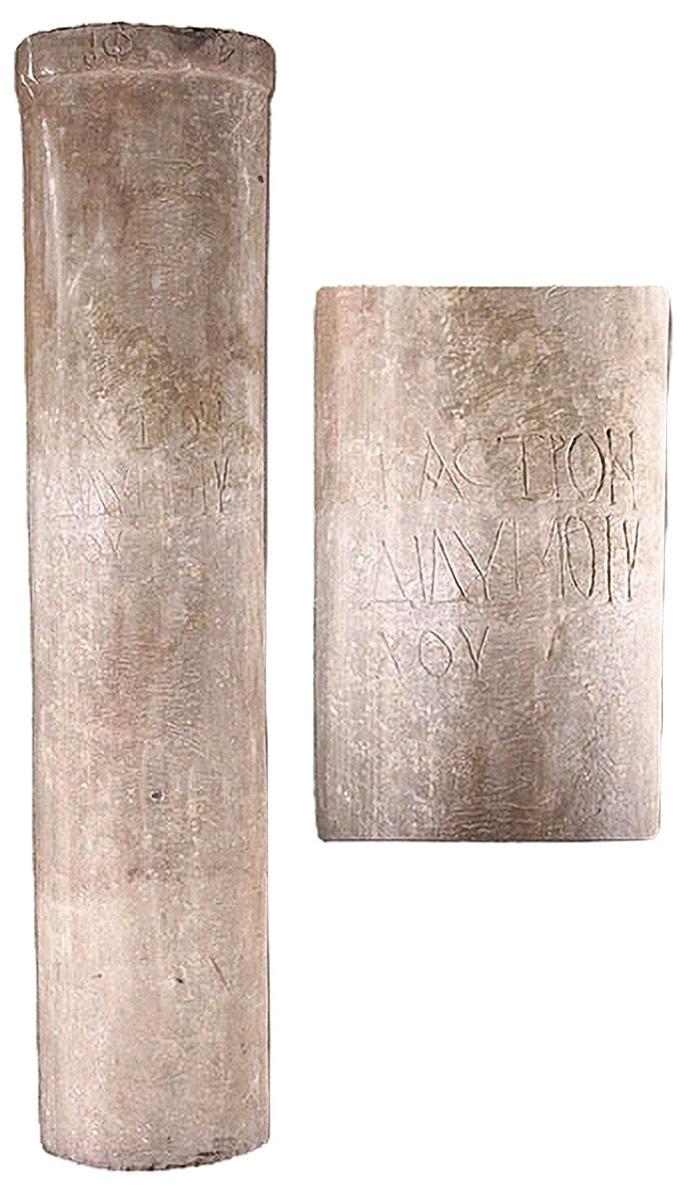
Column commemorating Khan Krum's capture of the town of Dimotika, in 812/813. National Archaeological Institute with Museum at the Bulgarian Academy of Sciences
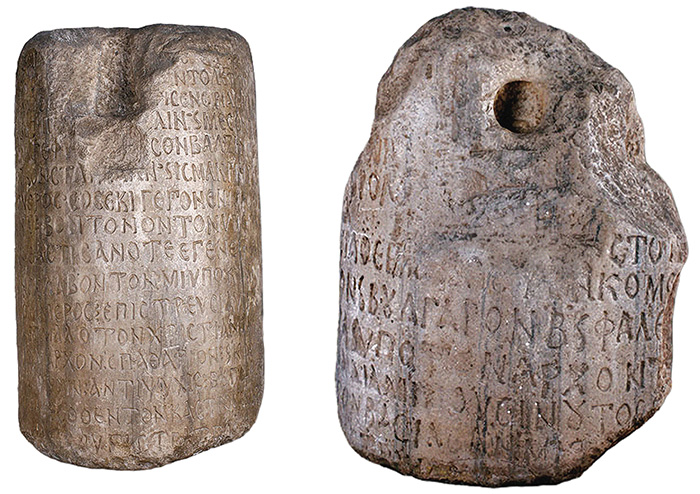
Inscription outlining the 30-year peace between Bulgaria and the Byzantine Empire signed in 815 (left) and an annexe. National Archaeological Institute with Museum at the Bulgarian Academy of Sciences
-
COMMENTING RULES
Commenting on www.vagabond.bg
Vagabond Media Ltd requires you to submit a valid email to comment on www.vagabond.bg to secure that you are not a bot or a spammer. Learn more on how the company manages your personal information on our Privacy Policy. By filling the comment form you declare that you will not use www.vagabond.bg for the purpose of violating the laws of the Republic of Bulgaria. When commenting on www.vagabond.bg please observe some simple rules. You must avoid sexually explicit language and racist, vulgar, religiously intolerant or obscene comments aiming to insult Vagabond Media Ltd, other companies, countries, nationalities, confessions or authors of postings and/or other comments. Do not post spam. Write in English. Unsolicited commercial messages, obscene postings and personal attacks will be removed without notice. The comments will be moderated and may take some time to appear on www.vagabond.bg.
 Vibrant Communities: Spotlight on Bulgaria's Living Heritage is a series of articles, initiated by Vagabond Magazine and realised by the Free Speech Foundation, with the generous support of the America for Bulgaria Foundation, that aims to provide details and background of places, cultural entities, events, personalities and facts of life that are sometimes difficult to understand for the outsider in the Balkans. The ultimate aim is the preservation of Bulgaria's cultural heritage – including but not limited to archaeological, cultural and ethnic diversity. The statements and opinions expressed herein are solely those of the FSI and do not necessarily reflect the views of the America for Bulgaria Foundation or its affiliates.
Подкрепата за Фондация "Фрий спийч интернешънъл" е осигурена от Фондация "Америка за България". Изявленията и мненията, изразени тук, принадлежат единствено на ФСИ и не отразяват непременно вижданията на Фондация Америка за България или нейните партньори.







Add new comment